What a useful custom-part RFQ should define
A useful RFQ should define what changes cost, manufacturability and acceptance—not just attach a drawing and quantity.
Not a generic blog. This knowledge base is built around the questions that change specifications, cost, manufacturability, quality and delivery in real industrial RFQs.
A useful RFQ should define what changes cost, manufacturability and acceptance—not just attach a drawing and quantity.
Model selection comes after fluid conditions, hydraulic duty, materials, seals, drive and installation are understood.
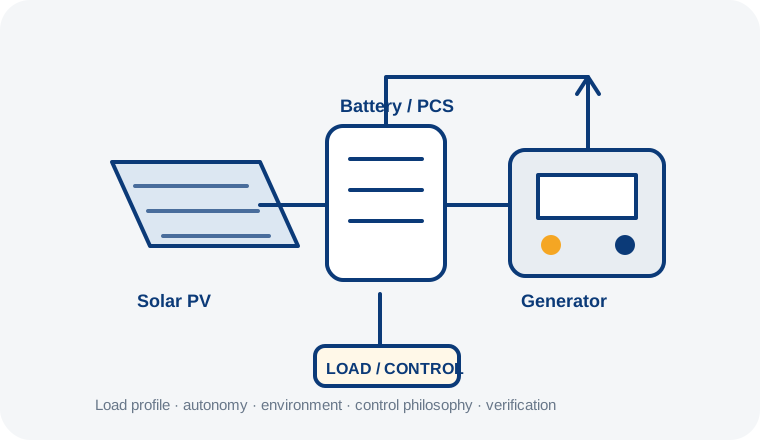
Generator, solar PV and battery storage choices should follow the load profile, autonomy target, grid condition, climate, controls and verification needs.
Good optimization removes unnecessary cost while protecting the dimensions, materials, performance and evidence that the application truly needs.
A material name alone is not a specification. Load, wear, corrosion, temperature, weight, manufacturing route, surface treatment, availability and cost should be reviewed together before a grade is locked in.
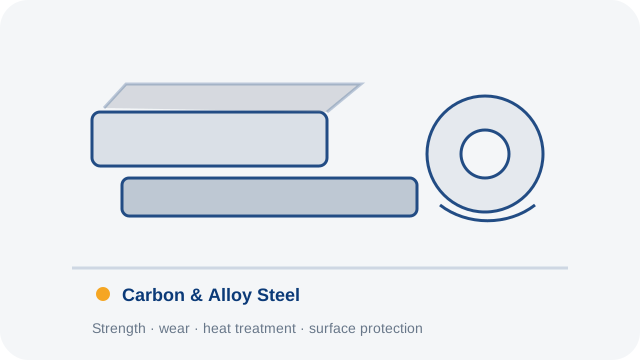
Often selected when strength, wear resistance, heat treatment or cost efficiency matter. Corrosion protection may be required depending on the environment.
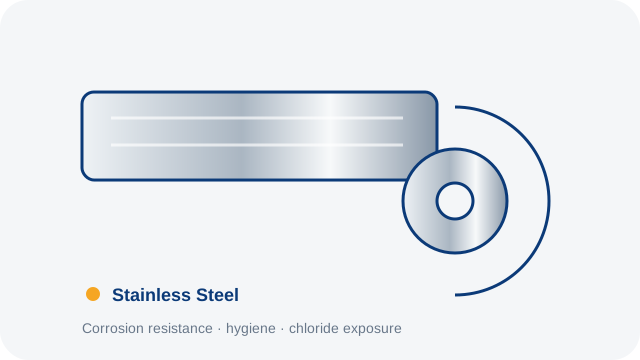
Useful where corrosion resistance, hygiene or appearance matter. Grade selection should consider chloride exposure, temperature, fabrication and cost.
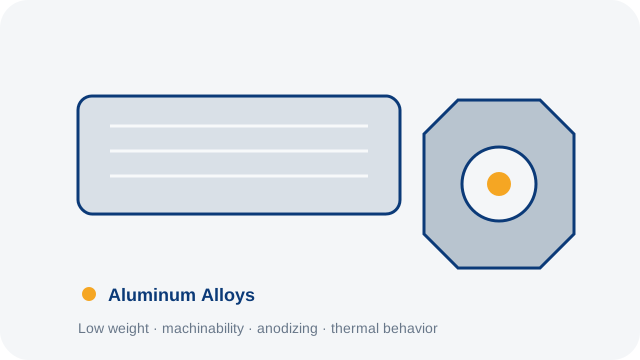
Low density and good machinability make aluminum attractive for weight-sensitive parts, housings and structures; grade, temper and surface treatment still matter.
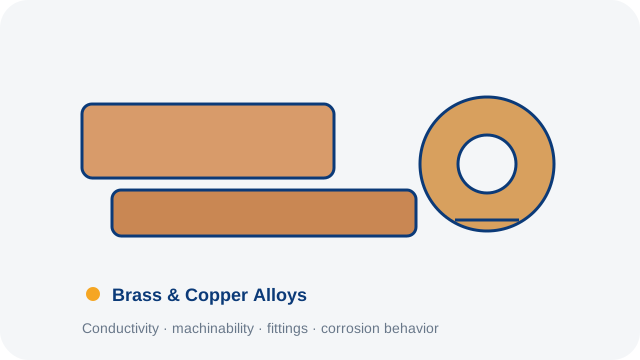
Common where machinability, electrical/thermal conductivity or fitting behavior matter. Fluid chemistry and galvanic contact should be considered.
POM, PA, PTFE, PEEK and other polymers can solve friction, chemical, weight or insulation needs—but moisture, creep and temperature limits differ greatly by material.
| Material family | Relative strength | Corrosion resistance | Weight | Machinability | Relative cost | Typical reason to consider |
|---|---|---|---|---|---|---|
| Carbon Steel | High* | Low without protection | High | Good* | Low | Strength, wear, cost efficiency |
| Alloy Steel | High–Very High* | Low without protection | High | Medium* | Medium | Heat treatment, fatigue, demanding mechanical duty |
| 304 Stainless | Medium–High* | High in many general environments | High | Medium | Medium–High | General corrosion resistance, cleanliness, appearance |
| 316 Stainless | Medium–High* | Higher than 304 in many chloride-related applications | High | Medium | High | More demanding corrosion exposure |
| 6061 Aluminum | Medium* | Good in many environments | Low | Excellent | Medium | Weight reduction, machining, anodizing |
| Brass | Medium* | Good in many suitable environments | High | Excellent* | High | Fittings, machinability, conductivity |
| POM / Acetal | Low–Medium* | Not subject to metal corrosion | Low | Excellent | Medium | Low friction, dimensional stability, lightweight parts |
Selection note: the table is a qualitative starting point only. Actual properties depend on grade, condition, heat treatment, section size and application. Chemical compatibility, food/medical requirements, pressure design, fire behavior and safety-critical use require project-specific verification.
A stronger RFQ reduces assumptions before supplier selection and gives quotation, quality and delivery a more reliable technical baseline.
Before choosing a model number, establish the operating point and the conditions that influence materials, seals, drive and life.
| Question | Why It Matters | Typical Decision Impact |
|---|---|---|
| What fluid / chemical? | Compatibility and safety start with the actual medium. | Wetted material, elastomer, seal, pump type |
| Required flow rate? | Defines the volume to be moved at the operating point. | Pump size, speed, motor load |
| Head / pressure? | System resistance determines the pressure duty. | Impeller / stage / pump type / motor |
| Temperature? | Changes material, seal, viscosity and sometimes motor/cooling choices. | Material, seal, clearances, configuration |
| Viscosity / solids? | High viscosity or particles can make a nominal pump unsuitable. | Pump principle, speed, passage size, wear protection |
| Installation conditions? | Suction, elevation, outdoor exposure, power supply and duty affect selection. | NPSH margin, motor, enclosure, base / connections |
Harsh environments do not only change the enclosure. They can affect usable power, starting, cooling, fuel, control and verification.
A practical generator, solar PV, battery or hybrid solution starts with the load and operating scenario—not with a panel count, battery capacity or generator model.
After each meaningful inquiry or project, we record what the customer asked, what was unclear, what changed cost, what changed risk, how quality was verified and what should be added to the next RFQ checklist.
Project → Questions → Evidence → Lessons → Better RFQ ChecklistKnowledge should become more useful after every real inquiry.
Send us what you have. For qualified projects, we provide a complimentary preliminary specification and sourcing review before quotation.